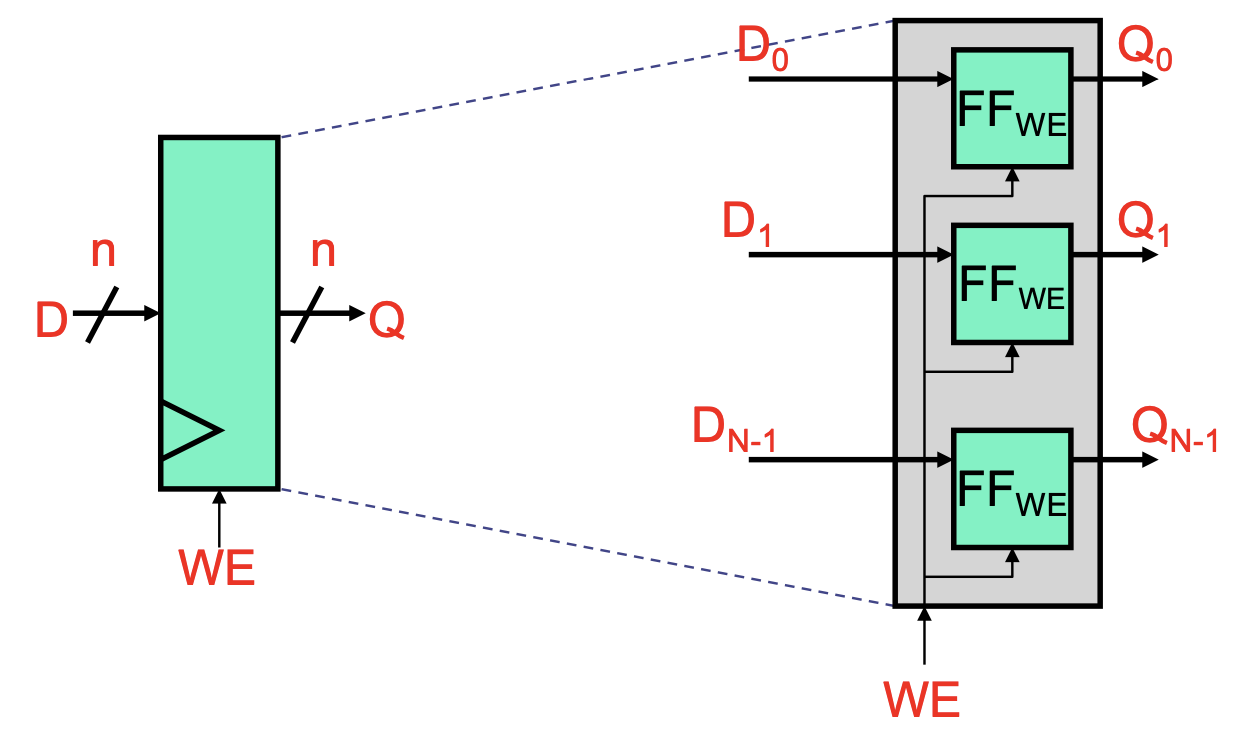
A register is a hardware component that can read and write a saved state. Its implemented as a D-flip-flop, which itself uses latches.
SR-Latch
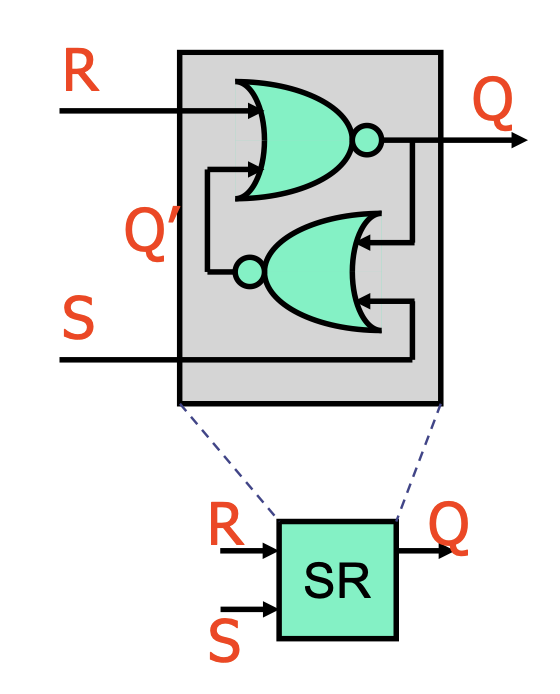
The SR-latch (set-reset) puts two NOR gates together to maintain a state Q. The set signal sets Q to 1, and R resets it to 0. If both are 0, then Q is unchanged; if both are 1, there’s undefined behavior.
D-Latch
The D-latch (data) extends the SR latch by providing a easier interface to work with: D is saved into the state as long as E is 1.
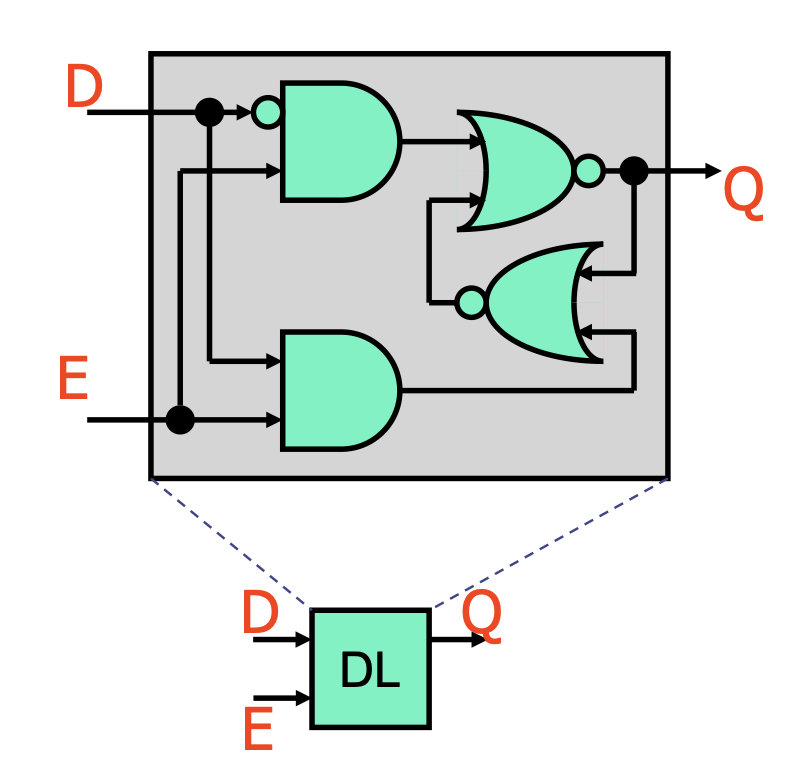
However, the D-latch is level-triggered, meaning it is open for writing as long as E is 1. It would be much easier to control if it’s edge-triggered, which only writes on an E transition (from 0 to 1 or 1 to 0), so there’s no need to worry about fluctuations in D.
D-Flip-Flop
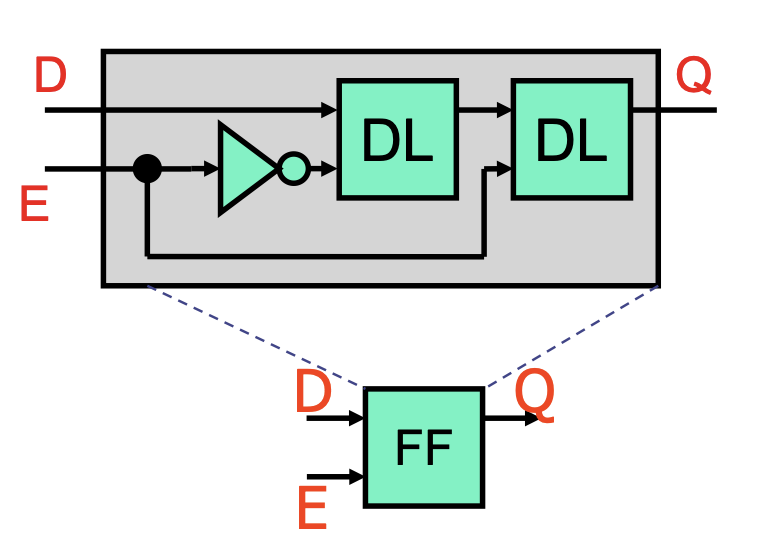
The D-flip-flop implements the edge-triggered idea above. Using two sequential D-latches enabled by inverse signals, the input D will only be saved if E changes in the middle of the two latches—thereby achieving our desired effect. In this setup, E is commonly set as the clock signal, so D will periodically update on every clock tick.
To add an extra write-enable WE control to the flip flop, we can use a mux to decide the input: the state value if WE is 0 and D if WE is 1.
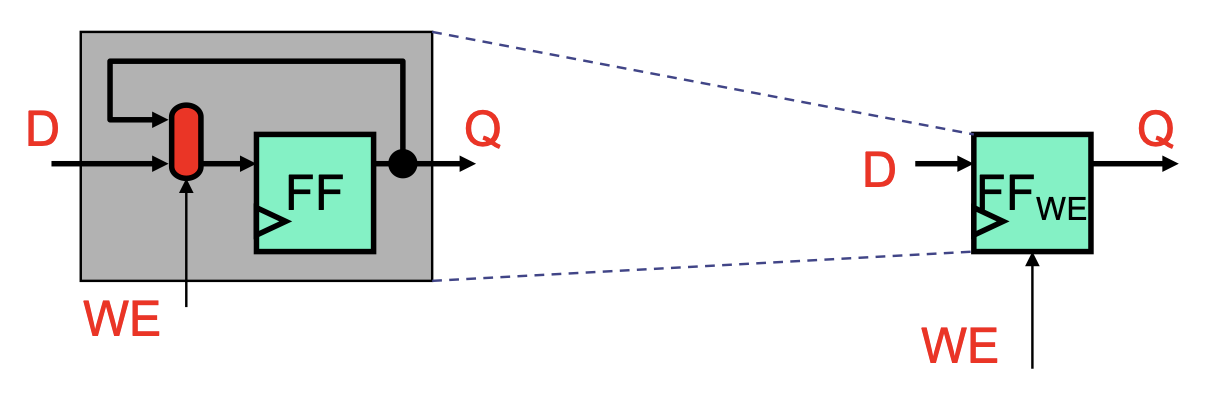
Putting WE wire, we get an N-bit register. The input is saved only on the clock edge when WE is 1.