Control as inference is a probabilistic framework that recasts ♟️ Reinforcement Learning through the lens of 🧬 Variational Inference in a 🪩 Probabilistic Graphical Model. The key idea of this framework is that unlike other optimal methods, this can model suboptimality and give us "soft" policies that explain stochastic behavior.
The core idea is that a trajectory
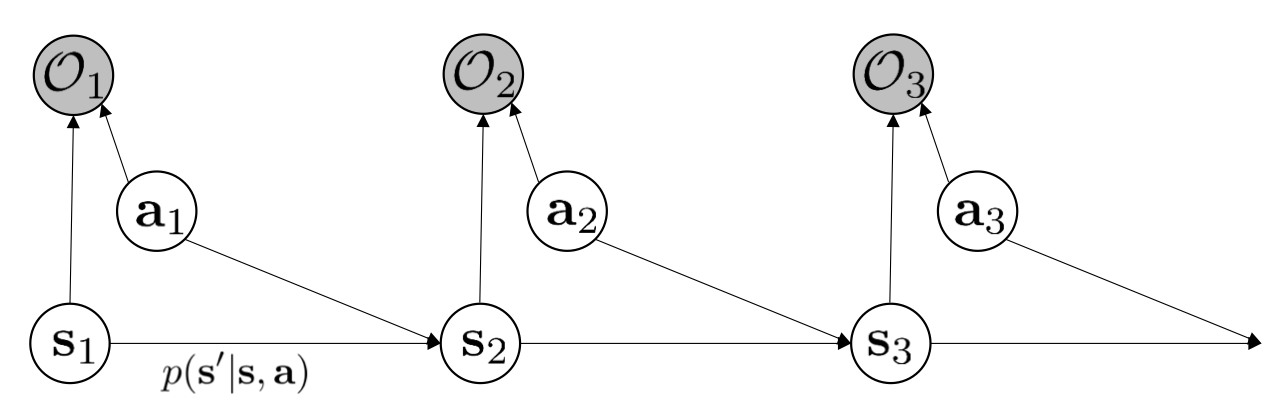
This optimality variable allows us to describe the probability of optimal behavior: that is, the probability of a trajectory
In other words, it's the probability that the trajectory can actually happen,
Planning via Inference
Within this framework, we can compute multiple useful quantities.
- Backward messages
, ie how likely we are to be optimal at and onwards. - Optimal policy
. - Forward messages
, ie probability of reaching a state , given optimal behavior.
Note that this terminology takes inspiration from the ☂️ Hidden Markov Model > Forward-Backward Algorithm, with a similar message passing technique.
Backward Message
The backward message is
and the first term, the backward state message, is
We can assume that
The backward message passing thus amounts to alternating between computing the two messages starting from
Though the above equations don't seem very intuitive, we can recast them in the form of 💎 Value Iteration if we let
Then, the above steps are the following: 1.
Note that rather than computing the maximum, our log of the exponentiation finds a "soft" maximum (not to be confused with softmax).
Policy Derivation
Using the backward messages, we can derive, through 🪙 Bayes' Theorem,
Note that in context of our value functions, this is equivalent to
which essentially gives better actions an exponentially higher probability.
Forward Message
A forward message
where
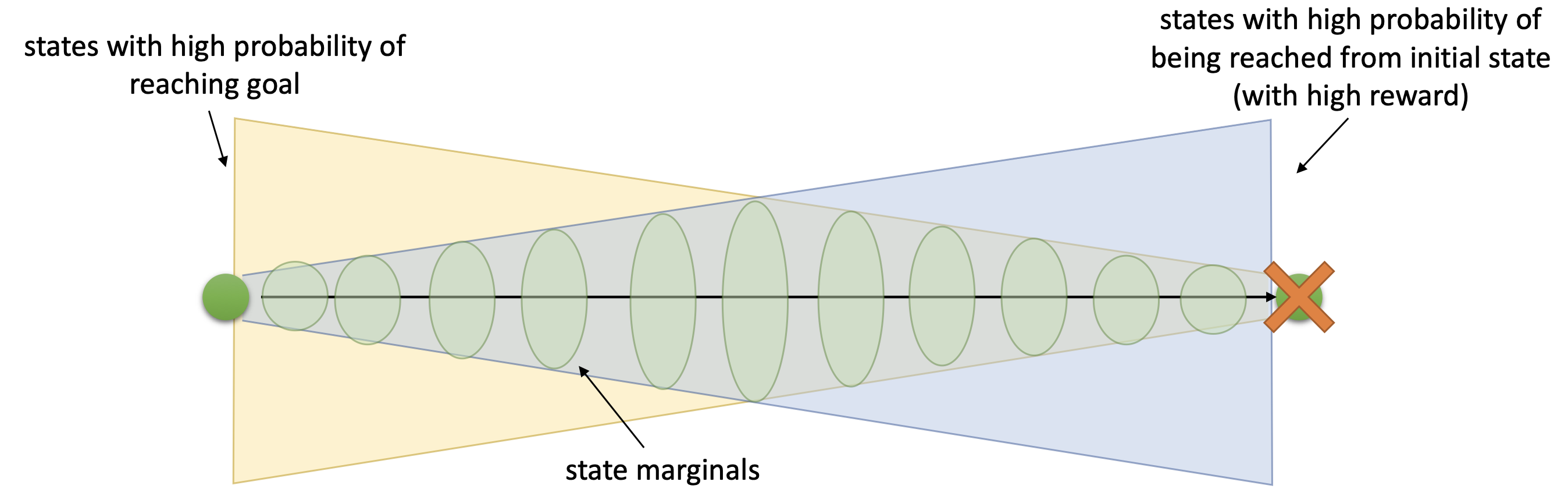
More importantly, if we now compute the state marginal under optimality, we find
Intuitively, this tells us that the state distribution is the intersection of states with high probability of reaching the goal (backward) and states with high probability of originating from the initial state (forward).
Fixing Optimistic Transitions
Unfortunately, an important problem with the above approach is the equation
which describes an "optimistic" transition (as opposed to a normal expectation, in 💎 Value Iteration). In taking this "soft" max over the future states, it is based on the assumption that the future state is also optimal, which is up to the stochastic environment transitions and not within our control. That is, it is confusing two questions into one:
- Given that we obtained high reward, what was our action probability? This is the question we want to answer.
- Given that we obtained high reward, what was our transition probability? This is not controllable, and thus should not factor into our planning.
To address this, we'll harness 🧬 Variational Inference and find another distribution
First, to enforce the dynamics, we define
where
Tightening the bound by maximizing this quantity is thereby equivalent to maximizing reward and action entropy. From here, it can be shown that the policy
with value functions
These definitions for value functions and policy can be immediately substituted into 🚀 Q-Learning and 🚓 Policy Gradients for their soft optimality variants, bringing the benefits of improved exploration, easier fine-tuning, and stronger robustness. Using a similar idea gives us 🎲 Entropy Regularization, which forms the basis of 🪶 Soft Actor-Critic.