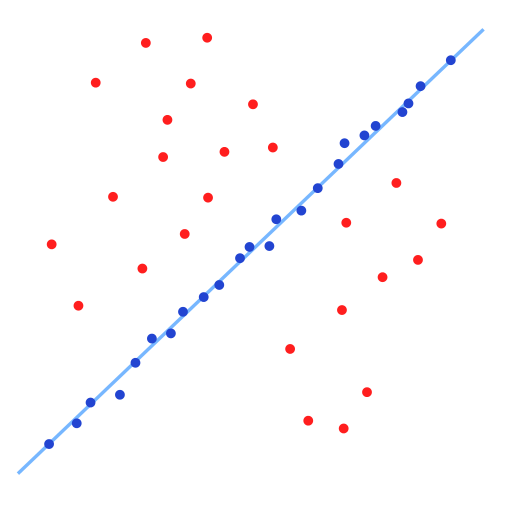
Random Sample Consensus (RANSAC) is a method for fitting a model to data that contains potentially-harmful outliers. In this sense, RANSAC can also be thought of as an outlier-filtering algorithm that estimates model parameters after removing outliers.
Define the "minimal sample set" as the smallest set of datapoints we need to define a model. The RANSAC algorithm essentially fits a bunch of minimal sample sets selected at random and chooses the best one.
More specifically, the algorithm repeats the following for
- Randomly choose the minimal sample set of
datapoints. - Fit a model to this set.
- Check each datapoint's error in this model via some pre-defined error measure, and count the number of errors that fall outside a certain threshold—these points are outliers.
At the end, choose the model that has the fewest outliers. Alternatively, we can stop the loop when we fall within a certain number of outliers.
Though this algorithm doesn't deterministically guarantee the best model, we have some probabilistic guarantees due to randomization. If
Linear Regression
In the most simple case, RANSAC can be used for linear regression. Our minimal sample set consists of two points, which define a line. The algorithm then tries many possible lines, and if there are enough inliers, we'll eventually randomly choose two inliers and get the desired linear model.