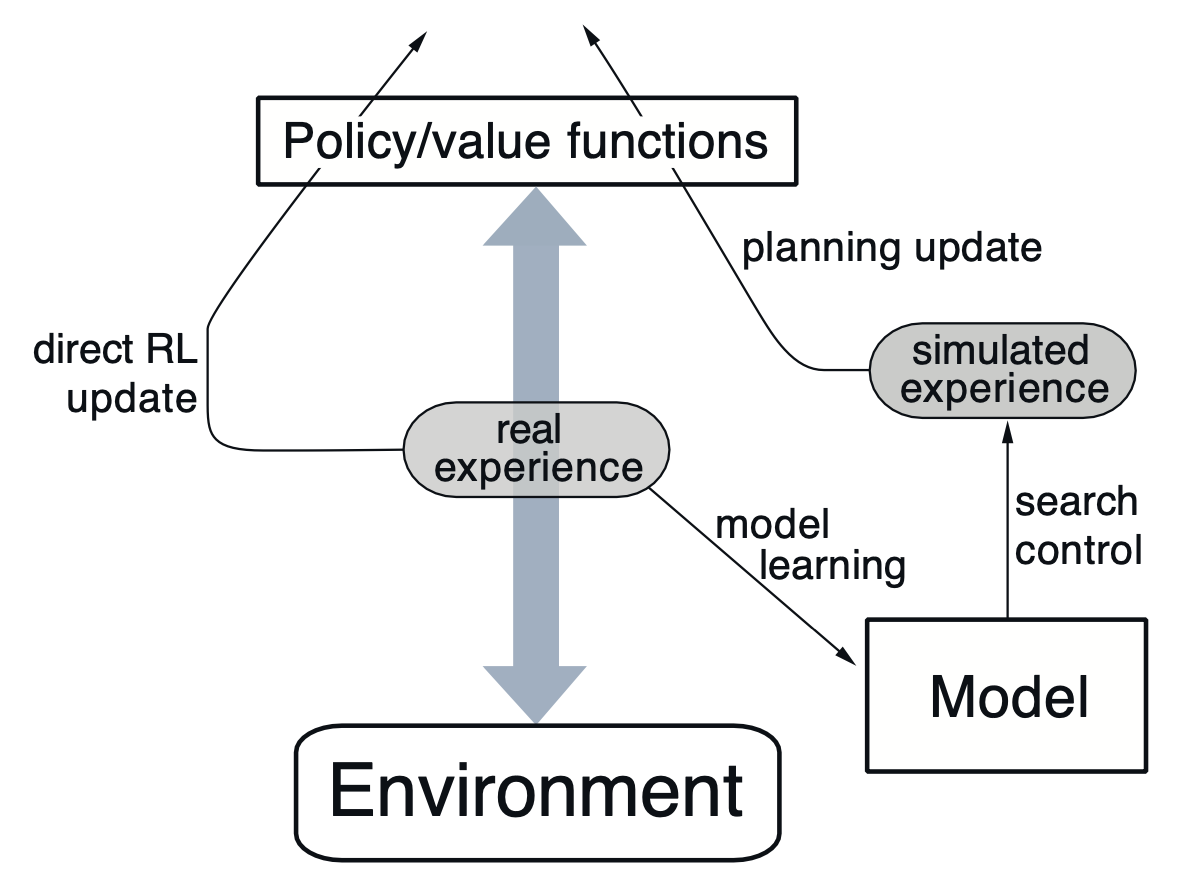
Dyna is a class of reinforcement learning algorithms that bridge model-free and model-based learning. It uses a learning algorithm that takes experiences from both the environment and the model simulation, thereby presenting two separate paths for learning—one directly through experience and one indirectly through model learning and planning.
Dyna-Q
One prominent example of this class is Dyna-Q, a 🚀 Q-Learning-inspired algorithm. It augments the standard Q-learning updates via samples from the environment model, thus encouraging faster convergence.
The algorithm is as follows:
- Given state
, pick action with 💰 Epsilon-Greedy and observe . - Update model
and using our transition. If our model is deterministic, our update is simply
- Perform the Q-update using our immediate experience,
- Repeat
times: - Sample
from a buffer of past states. - Simulate action
on state via our model,
- Sample
3. Perform another Q-update with our simulated experience,
Model Updates
If our environment is non-stationary, we would need to continuously update our model. Usually, this happens when our inaccurate model leads to an suboptimal policy that goes to some overestimated state; experiencing the actual value then corrects the error in our model.
A more general solution would be to directly encourage exploration. One method, similar to 🤩 Optimistic Exploration, is to track "time since last visit" for each transition. Then, we can augment our rewards by adding a small bonus dependent on this record, which encourages our algorithm to revisit transitions that haven't been seen in a while.
Prioritized Sweeping
Dyna-Q selects
Prioritized sweeping is an upgrade to the buffer selection process that maintains a 🔑 Priority Queue with the key being the update magnitude. Specifically, we replace the final simulated experience step with the following:
- Take
from the top of our priority queue. - Simulate action
, observe , and perform Q-update
- Using our model, check all
that lead to : - Compute
, the predicted reward for action in , and compute the update magnitude
- Compute
2. If $p$ is above some threshold, insert $(\bar{s}, \bar{a})$ into the priority queue with key $p$.