Group Equivariant CNNs (G-CNNs) generalized the standard 👁️ Convolutional Neural Networks' translation 🪞 Equivariance to other symmetries, specifically rotation and reflection.
Symmetric Groups
A symmetry of an object is a transformation that leaves it invariant. The set of symmetric transformations is a symmetry group.
The translation, rotation, and reflection operations are all symmetries for our feature map. Thus, they form the p4m group parameterized by
This matrix is applied to 📽️ Projective Geometry > Homogenous Coordinates for the transformed pixels. That is, a member of the group
Group Functions
However, observe a transformation on a pixel is equivalent to the inverse transformation on the image; for example, moving a pixel to the left in
Intuitively, this is saying that the value at point
A feature map in p4m space and the operations a group can perform on it is below.
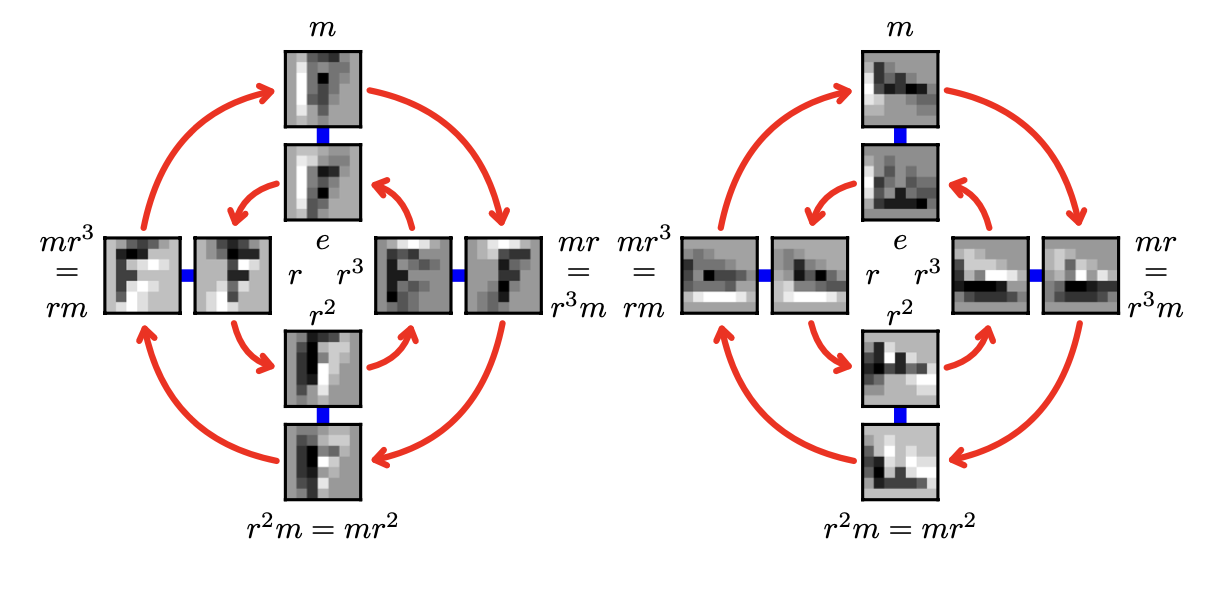
G-Convolutions
Now, we can generalize standard convolutions to groups. Note that the original convolution is CNNs is performed on a group consisting of translations; for a filter
for each offset
The key insight here is that
Thus, instead of thinking about
Therefore, we can generalize to any symmetric group
This is the G-convolution that acts on the input feature map.
However, since this results in a feature map
Pooling layers can be defined using the same idea, and nonlinearities are still performed over each value,