Markov random fields use an undirected graph to model dependences over a probability distribution. For each clique
Using factors, we construct a probability distribution
where
that ensures the distribution is valid.
This form of the graphical model is extremely general. In fact, a 🚨 Bayesian Network can be represented in this form using the transformation (called moralization) below.
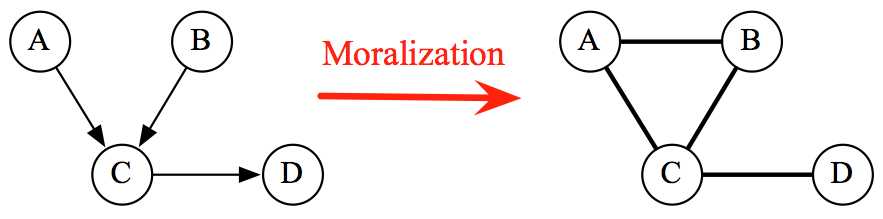
Independence
Two variables are dependent if they're connected by a path of unobserved variables. Thus, independence is achieved when the variables are separated by a "wall" of observed variables.
The Markov blanket
Factor Graphs
Another way to visualize Markov random fields is with factor graphs, with explicitly separates factors from the random variables. This makes the computation and dependencies clearer.