SVD decomposes a matrix
where
- The singular values
are roots of the nonzero eigenvalues of both and . This also means that we have nonzero singular values. - The left singular vectors in
are eigenvectors of . - The right singular vectors in
are eigenvectors of .
The singular values in
for left and right singular vector
Computation
To compute the SVD, we start with
where
where
and
Forms
Observe that if
such that SVD is equivalently
Additionally, note that if
Each term is a rank-one matrix with range spanned by
Interpretation
Geometrically, we can interpret SVD as a rotation, scaling, and another rotation.
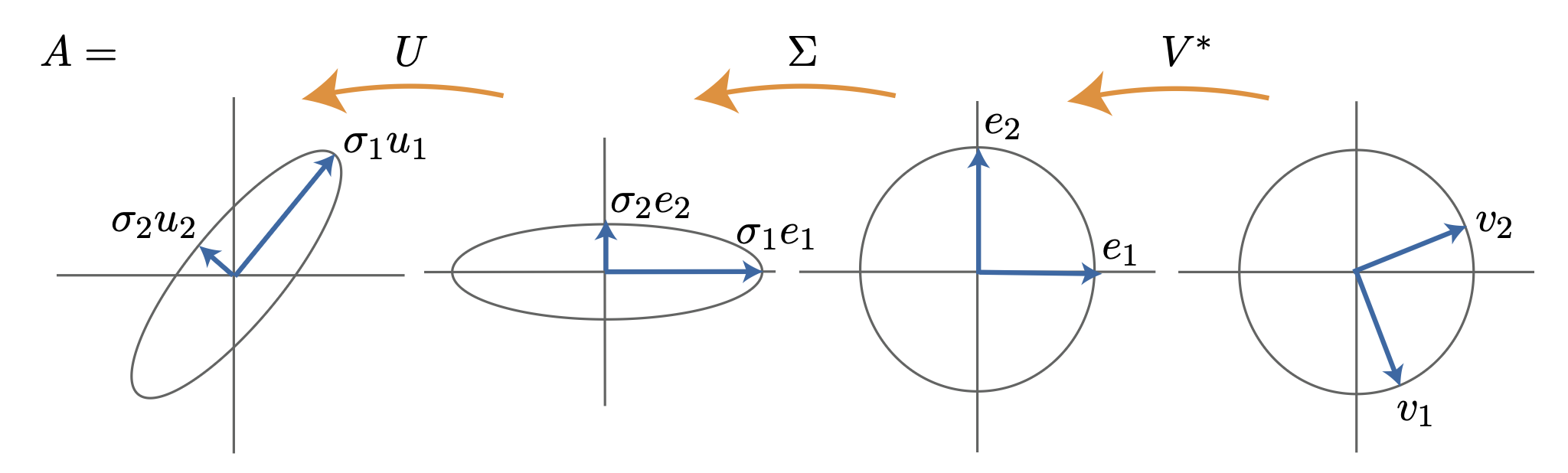
From this, we can see that for any vector
with equality when
Additionally,
- Columns of
and form orthonormal bases for and . - Columns of
and form orthonormal bases for and .
Moore-Penrose Pseudoinverse
The Moore-Penrose pseudoinverse computes the minimum-norm least squares solution to
These terms represent orthogonal projections of
Using the definition of SVD and simplifying for the minimum-norm solution, we have
and thus the Moore-Penrose pseudoinverse is
Lastly, if
Or, if its range fully spans
Matrix Approximation
We can approximate
This is the best approximation of
Furthermore,
where the subscript denotes the spectral 📌 Norm.